My thoughts, feelings, and opinions, as yes, though in continuous agonizing pain, underweight for six foot, I can think. And feel. And wonder why they treat this the way they do. I don't run and if I walk, not on a wheel.
I welcome readers: those here to download and cheat, my apologies:
PRIVACY NOTICE: Warning – any person and/or institution and/or Agent and/or Agency of any governmental structure including but not limited to the United States Federal Government also using or monitoring/using this website or any of its associated websites, you do NOT have my permission to utilize any of my profile information nor any of the content contained herein including, but not limited to my photos, and/or the comments made about my photos or any other “picture” art posted on my profile.
You are hereby notified that you are strictly prohibited from disclosing, copying, distributing, disseminating, or taking any other action against me with regard to this profile and the contents herein. The foregoing prohibitions also apply to your employee , agent , student or any personnel under your direction or control.
As a patient with RSD/CRPS, I have to guard against this sort of care. The physician asked me to roll over so she could see it better. That being my RSD leg, so what came next took 3 months to heal, also caused my RSD to spread, but was sickeningly painful, but is contrary to care of ANY blister (as the skin is the only barrier against infection or creating further injury), as with RSD, your affected part isVERY hypersensitive to PAIN, this provider was apparently unaware I am healed now--3 months later. Steep price to pay. I wound up bed/homebound for nearly 3 months with home health and 3 day a week home health. I only went to appease my PCP. I DO know how to treat a blood blister-leave it alone & protect it.
The home Health Agency that Followed (I am too tired to get to my PCP)
TITLE:Have a contingency plan; don't have rare or
painful disorder
PROS: Animal Friendly
& shower aides are awesome
CONS
I informed them way
ahead of time I was having a portacath placed.However, as soon as this was done--I was, with NO NOTICE, promptly
discharged-with no other arrangements made. My physician was not notified, nor
was I--until AFTER the port was placed, and advertised services were NOT ONCE
PROVIDED, unless it was a "Well, I am not supposed to," and you were
made to feel so privileged that they did their jobs.Wow!They came into this knowing I had a rare and highly painful illness, and
I had to loan the primary RN a book on it, and it was returned 1 week before
discharge.I told them my port was being
place during mid---Feburary; the port was placed March 14; and I was
IMMEDIATELY discharged of ALL services-no notice, no recommendations of other
agencies that handle ports.
I am seriously considering
going to ER, I swear-I called the on call neurologist no go so far, but
it's only been a little bit. I take Fioricet (minus codeine) with
Tylenol and I have noise cancellation headphones, and swear to GOD-they
used to be my stepdad's before when he had to wear hearing protection
when working and I am close to that: wake up with headache: and she
described it correctly when it's like getting smacked over your
head.....and people cant get that NOISE hurts!!! A few fibro and you
guys...makes you want to climb the dang wall-and the thing that makes me
feel so bad is one noise is my CA TS, who I adore more than anything.
I know Jessica's dad, and he told me that "well, if you don't WANT to
do ketamine, I hear they've had success with hypnosis-try that. As for
my daughter, she did it the 'ole fashioned way with ketamine." Knowing
full well I have no resources to pay for it, stupid jerk. I am glad she
seems to have turned out well. What do I have to mortgage? My $40 TV?
Like the $150 this month I spent total on the small amount of the
cream and the nasal spray. Now I can't pay my phone bill and that guy
upstairs walks loud. Got call now that I have NO HELP because the
agency (GENTIVA) won't even give you a home health aid--NO NOTICE!!
I have another doctor appointment (Oh, yay, the $75 I had left to my name, with which I hoped to get some whole milk, A couple boxes of Instant Breakfast, etc--I now am supposed to spend $50 of it on cab fare to getting to yet another doctor appointment I will point out: in the same week--on the heels of spending $120 to go see the pain doctor for another spinal
block (and not a terribly effective one: it helped the lower leg but I
am getting NO relief from the dang thing by now, I am sorry to say.)
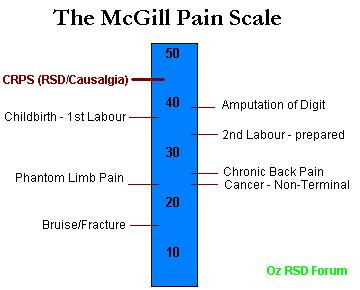
(that would be RSD at the top==and it's 24/7, 365
Now,
the malnourishment has me with a constant case of poor wound
healing,and blood sugars that bounce around to the point of sheer exhaustion, and no one does a darned thing about it since I was overweight before the surgery; well thanks cuz now I am:
constantly weak to the point where I am dizzy just standing up,
I sweat like crazy and though my heart FEELS like it's racing-it isn't
I suffer from hypotension and LOW heart rate--so even in wicked bad
pain, my BP never is much higher than 90-100/50 and my heart rate is
58-60; I had an emergency spinal block and it was because my pain was so
bad my heart rate is usually around 58. It was 138. My BP was at an
all time high of 130/28--and wonder why people had a hard time believing I was in pain? Or had RSD? Guess I understand now.
I get exhausted going to the bathroom.
I I shake just doing simple tasks
I have the runs (it happens)!!!!!!
my foot is taking forever to heal
my body won't respond to treatment
I lose almost 60 pounds--WITHOUT dieting; and people keep just CONGRATULATING ME.
I TALK AND PEOPLE THINK I AM "STONED" BECAUSE I CAN'T GET "NOURISHMENT TO MY DAMNNED BRAIN!!!"
You
just tell me to eat. I freaking can't do it, it ain't that damned
simple! You think I can pick up where prolonged RSD pain left off???
If
someone would PAY ATTENTION and REALIZE THAT even though my BMI had me
as though it may have been high BEFORE the RSD came along-- DO YOU NOT
UNDERSTAND AT ALL THAT I CAN'T "JUST DO THAT????"
YOU ASK ME, "WHAT IS THE PROBLEM?"
It would be known as denial (and not on my part).
Sure as hell I am frustrated-I have been shouting this from the
rooftops and who's listening.........hmmmm, only person I heard was the
friend on the phone and my cat meowing real loud. Denial that even someone people think is "heavy" can be malnourished. And that can cause you to be barely able to move.
This did not happen overnight:
I
THINK THIS HAS BEEN CLEAR ENOUGH. I could get through this IF YOU
WOULD HELP ME NOW AND NOT WHEN I END UP IN A DAMNED NURSING
HOME---because some FOOL comes along and says
"Oh, she has to have 24 hour care--she can't even eat!
Then really--this is my LIFE we are talking about, not just something to joke about. Do you think that the fact I seriously considered going to the ER-but that was no more of a solution that spending $50 of my food money to
see a doctor who can't help with this problem. A simple one that even
some perhaps use of the port-if I ever get the name of the surgeon.
That's my other chore today;
And I feel like I am having to climb Mount Everest--not Everett.
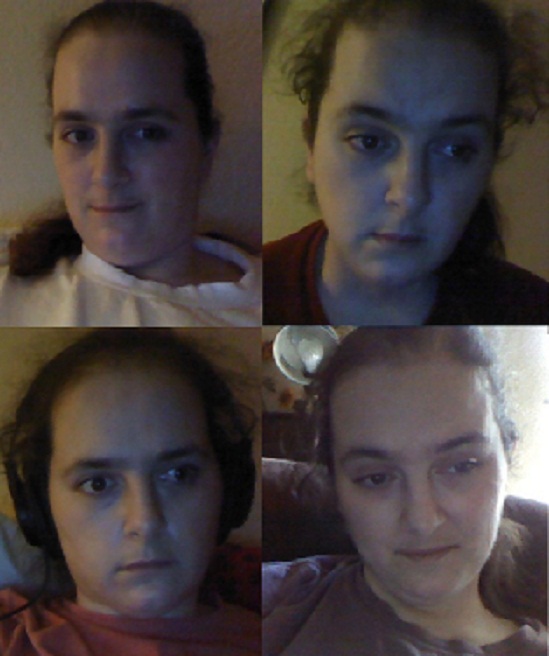
I used to look like this:
This was taken a week ago:
I look like SHIT-
PAY ATTENTION bottom right is still me. Don't ask for, ah, hell, here's today:
Ketamine
is growing in popularity, see this link for more information on the
success that even the FDA has admitted to. Problem is the explosive
growth of numbers of patients ending up on Medicare after use of their
previous insurance is exhausted. Regular insurances, that's about
$2Million in care before it runs out.
Previously controversial, it is proving less so:
APPROXIMATE COST OF KETAMINE IN DOLLARS AND CENTS:
• A 3-4 day ketamine infusion, on average is about $2-3,000 per day-in hospital;
• at an outpatient or tertiary site, about $2,000 per day.
• One course of 3 day treatment; of which most patients undergo about 5-10 treatments would cost about $15-20,000
(the cost of the surgery, by the way that triggered my disorder WAS $17,500).
If
that puts someone who requires well over (keeping in mind, my care for
home health is not included as it is yet to be submitted) an average of
$150,000/year for life, cost for a series of short-term ketamine
treatment, costing in the end maybe $50,000-80,000 offers a shot at a
life without the screaming agony of RSD which has even (though not
crossed my own mind) driven some to suicide—as children.
Or I could get ketamine and WORK, AND BE MAKING $60,000-80,000 AND be PAYING INTO the system.
TELL
THE GRIEVING PARENTS WHAT THEIR CHILD'S LIFE WAS WORTH, THAT YOU, MR.
PRESIDENT, CAN'T SIGN A PIECE OF PAPER, REQUIRING MEDICARE, SAY TO BE
COVERED IN ALL 50 STATES???
Why is ketamine so critical?
Approximately 1.5 million Americans suffer from CRPS/RSD in any given year.
Different kinds of pain in RSD
• in the beginning, the pain of RSD/CRPS is Sympathetically Mediated Pain.
Every
time there is a 3 month delay in the start of treatments (first line)
like spinal blocks, the pain becomes more of what is called
INDEPENDENTLY MEDIATED PAIN (this means it originates no longer in the
spinal nerves; but the brain itself.
3 months = 25% IMP & 75% SMP (still good chance at recovery with topical ointments, nerve blocks, etc.
6 months = 50% IMP & 50% SMP (multi-modal therapies must be used)
9 months = 75% IMP & 25% SMP
By 12 months, rule of thumb, almost 100% of RSD/CRPS pain is IMP.
http://www.rsdhope.org/imp--smp--crps.html
My
treatment began in the 11th month, when about 92% of pain is IMP and it
began with spinal block--as that is what MEDICARE has approved--not
things that work for IMP (and far more difficult to treat=aka, becoming
“refractory")….”
And yet, I must AGAIN be submitted to
only Medicare approved treatments for RSD/CRPS THAT ARE "ALLOWABLE BY
MEDICARE for WASHINGTON STATE.
Which means I did get to “skip to”
spinal blocks. They provide about 3 days relief thus far. And I have not
had one, and WILL NOT GET ANOTHER 3 DAYS of relief--which looks like an
oasis at this point-UNTIL I HAVE A SURGICALLY IMPLANTED PORTACATH. I've
had so much agony in my medical history; I HAVE NO IV ACCESS.
My
RSD Specialist--who does this day in and day out, in terms of starting a
simple IV, took 3 hours and countless sticks before a butterfly needle
was used when at least a 20-guage-21-guage needle be used in case of
emergency. WE WERE FORTUNATE. And I am used to being stuck: so the
problem? Each stick has a very good shot at spreading the disease from
my right leg to left arm, or if as is often the case, when done
improperly--it can-a simple needle stick, cause, full-body RSD, which by
definition is treatment-refractory.
A hospital may charge $2,000 just to place the catheter in the patient in day surgery.
This
is not including fees from the surgeon for the initial consult
(probably about $500 for the initial consult). No idea what fees are to
actually place the port?
And I need TPN now.
REASONS TO NEED TPN:
Reasons
I need the TPN are the following (the symptoms of the RSD being also a
portion of it as well, adding to the expense--even though study review
after review has repeatedly showed that patients do better at home in
recovery from just about anything
Reasons in my medical history that I would likely need TPN:
• Malabsorption
• Surgery
• Reflux
• Malnutrition
• Chronic adhesive obstruction
THE BOTTOM LINE AT THE CURRENT TRAP:
Grand total in charges are (without TPN): (Roughly, including the $2,000 for each spinal block) are about $10,000/month
Add the TPN and take it up to $16,000 +/month OR $192,000/year.
Now
do you see how so many end up on some form of public assistance? Most
insurances have a lifetime cap of $2 mllion. At $192,000/year, it will
provide respectable ca
For a time at least, average cost of home based TPN so that my body can heal.
• Have a prayer of fending off infection with a portacath
• Give me the energy level to be able to shower without assistance
• Build up a level of health where my body could withstand ketamine
At this rate, maybe I will live to see 50, maybe not-but unlikely.
o I make the most of it.
o BUT BECAUSE I LIVE IN WASHINGTON, NOT IN CALIFORNIA OR FLORIDA? EXCUSE ME, BUT THIS COUNTRY WAS BUILT ON EQUALITY.
o EQUALITY IN ALL 50 STATES.
.
I MUST FIND A NEW PRIMARY PHYSICIAN, BUT WHAT’S WRONG?
No physician wants to take me on as a NEW PATIENT because I am what is known as a "PROBLEM/VERY COMPLEX PATIENT."
Anywhere
else I TURN (aka, away from the doctor who ignored what was "classic
RSD Symptoms" which forced MY hand to step out of their system and go to
a neurologist I KNEW could make the diagnosis.
By the
time my chart landed (he is ONE of THREE doctors I know of that don't
put a COMPUTER between them and their patients) on the desk of and their
patients. Note the lack of COMPUTER chartng.
Right
now, the only 3 I would recommend to anyone with RSD. HOW MANY PCP’S
KNOW ANYTHNG ABOUT RSD? ONE WRONG MOVE practically, and you can damage
them permanently—leavin
And maybe would allow someone
in my condition, at 37, a chance of maybe even returning to work, should
the restorative therapies be initiated ASAP, the cost of KETAMINE is a
bargain since I was last employed as a Registered nurse,
Ketamine
is a risk maybe, but numbers are piling up so that MANY other states,
such as California and Florida allow Medicare reimbursement-NOT
WASHINGTON.
But if the
• RSDSA
• RSD Hope Foundation
• RSD Foundaton,
Would
all support ketamine in cases like mine, if my doctor recomends it as
AN OPTION that MAY BE APPRORPRIATE-SHOULD THIS NOT BE AVAILABLE NO
MATTER WHAT STATE I LIVE IN, WITHOUT MY HAVING TO TRAVEL OUT OF STATE
WHERE
80% IS COVERED
20% IS ON MY LAP
WHEN MY HARD WORK FROM AGES 15 UNTIL MY LAST EMPLOYMENT IN WHEN my poor health forced me to finally give up a career that:
• I loved.
• Allowed me to be of SERVCE TO OTHERS the way I WANTED TO.
• Yes, it did pay well
• PLUS I spent 5 years in University WORKING and paying taxes and DOLLARS INTO instead of sucking dollars out
Just ask yourself this, Mr. President, and Ladies and Gentlemen of Congress and the Senate:
Would
you not want the same care in your state, if something happened to you,
and you were not around to make sure that your CHILD, WIFE, HUSBAND,
PARTNER, ETC, becane unable to work, not able to afford housing without a
job of some kind, a CHANCE AT A LFETIME OF FREEDOM BE AVALABLE IN ALL
50 STATES?
DON'T ONLY MAKE IT AVAILABLE WHERE DOCTORS ARE ABLE TO, MAKE IT SO THAT DOCTORS ARE ABLE TO PROVIDE KETAMINE IN ALL 50 STATES.
$3.9 million PER patient. With how many of those 1.5 million with access to ketamine IF needed?
Sounds expensive to me to say “Aw, it’s only a small percentage of people, it’s gonna come out in the wash!”
Come and meet us:
Cost without ketamine is about $150,000-200,000/year for life.
Or $150K is a ONE TIME deal.
TPN and tube feeds or jobs with benefits, and productiveness to society-but equal opportunity MUST exist wthin healthcare
THIS IS OUR LIVES.
1.5 MILLION AMERICANS
or is it ONLY 1.5 MILLION AMERICANS
EFFECTIVENESS OF KETAMINE:
Case
notes of 33 patients whose CRPS pain was treated by the inpatient
administration of a continuous subanesthetic intravenous infusion of
ketamine were reviewed at Mackay Base Hospital, Queensland, Australia.
A total of 33 patients with diagnoses of CRPS who had undergone ketamine treatment at least once were identified.
Due to relapse,
12 of 33 patients received a second course of therapy, two of 33 patients received a third.
• There was complete pain relief in 25 (76%),
• partial relief in six (18%),
• no relief in two (6%) patients.
The
degree of relief obtained following repeat therapy (N=12) appeared even
better, as all 12 patients who received second courses of treatment
experienced COMPLETE relief of their CRPS pain.
The
duration of relief was also impressive, as was the difference between
the duration of relief obtained after the first and after the second
courses of therapy. In this respect, following the first course of
therapy,
• 54% of 33 individuals remained pain free for 3 months or more and
• 31% remained pain free for 6 months or more.
^
a b Goldberg ME, Domsky R, Scaringe D, et al. (April 2005). "Multi-day
low dose ketamine infusion for the treatment of complex regional pain
syndrome". Pain Physician 8 (2): 175–9. PMID 16850072.
OTHER OPTIONS FOR CRPS/RSD?
A spinal, or even a stellate ganglion bloock is going to help this? I have full body RSD!
Or
a spinal stimulator in the "new generations? Including the trial and
implantation? Approximately $60,000 for the implantation!
"Uncomplicated" maintenance of a SCS is about $7,000/ year.
Complications
include everything from bleeding, to spinal headache, leakage o flud,
increased pain at the site—and as well as an implant pain, also—to which
is:o Spread
o Infection
o Acute flare-up of the disorder, potentially causng serious seizures even:
This many complications--"uncomplicated” seems unlikely.
But it's being shoved at me--and hard. I don't want the stimuator--but every pain patient's worry is two-fold:
My doc will dump me if I say no.
The peppering with questions is a turn-off
RSD-appropriate care is a thing of the past when the same care is not available in EVERY STATE......AND KETAMINE IS NOT EITHER.
WE DEMAND EQUAL HEALTHCARE IN EVERY STATE. IT SHOULD BE EQUAL ACROSS THE BORDER!!!!
...Sign
this petition, please, and DEMAND as a US citizen, and a REGISTERED
VOTER and (even on disability in some form, we all do a TAXPAYER); that
President Obama and our Congress/Senate give us EQUAL ACCESS IN ALL
FIFTY STATES NO MATTER WHAT!!!--rather than forcing us to sell every
last possession.
And let's point
out a lifetime of remission from Ketamine treatment is cheaper than
expensive Spinal Stimulators, and jabbing needles into the spines of
those already in compromised health. Bring RSD/CRPS patients out of the
dark into the LIGHT--Please: give us a chance, we have suffered enough,
When did I invite the government into the doctor's office with me?
Never! If the AMA would "grow a pair" and tell them to get out...we'd be in a dream world here in the US!
They talk about the "war on prescription drug abuse."
Try "War on abusing those in need of a prescription for pain-or that are:
IN FUCKING PAIN THEY COULDN'T BEGIN TO IMAGINE
Fuck my government!!!
I
never did AT ANY POINT, once...SINCE HAVING ANY CHRONICALLY PAINFUL ILLNESS......INVITE THE STUPID PRICKS INTO MY EXAM ROOM WITH MY DOC-KISS MY FUCKING ASS WOULD CROSS MY MIND THESE DAYS!!!!
A FLUNKEY WITH A HIGH SCHOOL DIPLOMA AND A DRIVER'S LICENSE-AND MAYBE, JUST MAYBE IS THE ONE OR TWO YEARS OF "GENERAL STUDIES" (OR "POLITICAL SCIENCE IS MORE LIKE IT) TELLING OUR DOCTORS HOW TO WRITE PRESCRIPTIONS FOR SCHEDULE 2 NARCOTIC PRESCRIPTIONS FOR THOSE ON THEM:
AS THEY ARE "SUPPOSED TO TAKE/DISPOSED OF THEM,"
NOT TO MENTION DECIDING:
WHAT MEDICATIONS ARE PRESCRIBED FOR WHAT CONDITIONS!!!!!
AND TREATING PEOPLE ON THEM AS IF THEY ARE SO ADDICTED TO "THEIR PAIN MEDICATIONS" THAT WE MUST BE "CLOSELY MONITORED WITH HAIR SAMPLES AND RANDOM OR REGULAR UA'S.
THE ONES WHO GET THE MOST SHIT FROM A GOVERNMENT WHO ARE PROFESSIONALS AT DOLING OUT SO MUCH OF IT--ARE THE ONES WHO PASS THEIR UA EVERY SINGLE TIME, WITHOUT FAIL.
THIS MAKES EVERY BIT OF SENSE TO ME-AS THE STUPID FUCKS WHO GOVERN HANDLING OF BEEF BEING INVOLVED IN THE HANDLING OF NARCOTICS!
WHEN THEY GET ACCESS TO MY MEDICAL CHART AT WILL! SO IS IT THAT THE LAWS HIPAA APPLIES TO EVERYONE EXCEPT THEM???
THIS IS MY PAIN--SINCE I KNOW MORE THAN ANYONE (EXCEPT YOU, MR. FDA)
My pain is too distracting that I have trouble carrying on a conversation with than five minutes, ANYONE
I feel like I have been doused in lighter fluid and lit on fire.
Then, someone grabbed the wrong pail, and instead of WATER to put it ouut, they threw grease on the fire;
My pain exploded in size, strength, and the willingness to go out is ZERO.
WHEN I AM TOUCHED
It
feels like they've taken brillo pads, wire scrub brushes, and the like
too me.
And scrub my open, raw and bleeding wounds with them.
This comes from the touch of my cats tail as he brushes by--or worse: when he jumps on my lap, just to cuddle.
SO--OPEN MY FILE-I'VE NOTHING TO HIIDE-EXCEPT ONE THING: MOST
Some days I function okay. But since that ER doc filleted my foot?
Not so much.
I'm
trying to not let it own me; but those "pain support sites;" even
RSDSA's on FB led me to have to change my email account. And delete my
FB account.
There are three reasons to consider sympathetic
blockade to facilitate the management of RSD / CRPS. First, the
sympathetic block may provide a permanent cure or partial remission
of RSD / CRPS. Second, by selectively blocking the sympathetic nervous
system the patient (and physician) will gain further diagnostic
information about what is causing the pain. The sympathetic block
helps determine what portion of the patient's pain is being caused
by malfunction of their sympathetic nervous system. Third, the
patient's response to a sympathetic block provides prognostic
information about the potential merits of other treatments. 25-27
There is evidence that there might be a role for sympathetic blocks
in preventing RSD / CRPS. A retrospective study demonstrated that
the prophylactic use of sympathetic blocks in patients with a
history of RSD / CRPS decreased the occurrence rate of the disease
from 72% to 10% after re-operation on the affected extremity.
28
If sympathetic blocks are not properly performed and evaluated,
time and money will be wasted, and diagnostic-prognostic information
will be lost. A good sympathetic block should increase the temperature
of the extremity without producing increased numbness or weakness.
The sensation of warmth tells the patient that they have had a
sympathetic block. If the block causes numbness or weakness, more
than just the sympathetic nerves were blocked and the patient
will get an overestimation of the amount of their pain that is
contributed by their sympathetic nervous system; hence, the diagnostic
and prognostic value of the nerve block would be lost. The amount
of pain relief and improvement in range of motion and in exercise
tolerance should be noted by the patient and recorded by the physician.
This information about the patient's response to sympathetic blockade
will serve as a prognostic indicator for rehabilitation following
the series of sympathetic blocks and it will help the patient
decide if a permanent block (destruction of the nerve by sympathectomy)
would be appropriate. Also, the information will aid in directing
future medications in a more rational manner. Some patients will
experience a "booster effect" with each sympathetic
block, i.e. each successive sympathetic block in the series provides
greater and greater pain relief and improvement in exercise tolerance.
The maximum sustained benefit from a series of sympathetic blocks
is usually apparent after a series of 3-6 blocks. Even if the
original site is unresponsive to sympathetic blockade, future
exacerbation of RSD / CRPS symptoms at the same site or at a distant
site may be responsive to 1-3 sympathetic blocks. THE GOAL IS
ALWAYS TO TREAT BUT DON'T OVER TREAT.
Sympathetic blocks are usually performed by a pain specialist
trained in anesthesia. In experienced hands, these nerve blocks
can be performed with minimal discomfort to the patient with or
without IV sedation. Complications from sympathetic blockade are
extremely rare. However, it is always possible for the local anesthetic
to be inadvertently injected into a blood vessel or into the spinal
fluid. If this should happen, the patient may temporarily become
weak and lose consciousness. For safety reasons, sympathetic blocks
are always performed under conditions where the vital signs (blood
pressure and breathing) can be monitored closely. Patients should
not eat for 6 hours prior to a sympathetic block. For further
information about safety in performing nerve blocks refer to the
web site for the Anesthesia Patient Safety Foundation: http://www.apsf.org/
A sympathetic block of the upper extremity is called a stellate
ganglia block (SGB). The SGB is performed by inserting a small
needle along side the windpipe (trachea). Patients are informed
that they may notice a temporary change in the tone of their voice
following the block because some of the local anesthetic may partially
numb the vocal cords. They are also informed that they should
sip fluids and take small bites of food immediately after the
block. The numb ness around the vocal cords temporarily places
the patient at a slight risk of coughing in response to drinking
and eating. The patient may also notice a temporary drooping of
their upper eye lid due to the SGB (Horner's sign). A sympathetic
block of the lower extremity is called a lumbar sympathetic block
(LSB). For patient comfort and safety, LSBs should be performed
with the aid of a fluoroscope (X-rays). Videos of LSBs and SGBs being
performed can be found below at the end of this section.
As noted previously
in the Guidelines, there may be point-tender spots in the muscles of the
affected region due to small muscle spasms called muscle trigger points
(myofascial pain syndrome). The patient may obtain significant relief
of the diffuse pain due to RSD / CRPS from a sympathetic block but the
pain due to muscle trigger point(s) may persist. Local injection of
local anesthetic into the trigger point region and/or application of
physical therapy techniques after a sympathetic block may be necessary to provide further relief of pain.